52 BCE – Roman Conquest of Gaul
The conquest of Gaul by Julius Caesar between 58 and 50 BCE represented one of the most significant military campaigns in ancient history. After eight years of warfare, Caesar defeated the Gallic tribes led by Vercingetorix at the decisive Battle of Alesia in 52 BCE. This victory incorporated modern-day France into the Roman Empire as the province of Gallia. Roman administration brought roads, cities, aqueducts, and the Latin language that would evolve into French. The conquest created a Romano-Gallic culture that became the foundation of French identity, with many modern French cities (including Paris, originally Lutetia) originating as Roman settlements. Archaeological evidence and Caesar's own Commentarii de Bello Gallico provide detailed accounts of this transformative period.
July 14, 1789 – Storming of the Bastille
The storming of the Bastille prison on July 14, 1789, became the iconic opening act of the French Revolution. Though only seven prisoners were held there, the fortress represented royal despotism. A crowd of several thousand Parisians, armed after seizing weapons from the Invalides, overwhelmed the garrison and seized the building. News of the Bastille's fall spread rapidly across France, triggering widespread revolts against aristocratic privilege. The event forced King Louis XVI to recognize the revolutionary government forming in Paris and became France's national holiday. Contemporary accounts and the detailed historical record confirm its pivotal role in destroying the ancien régime.
December 2, 1804 – Napoleon Crowned Emperor
Napoleon Bonaparte's coronation as Emperor of the French on December 2, 1804, marked the culmination of his rise from revolutionary general to absolute ruler. In a carefully orchestrated ceremony at Notre-Dame Cathedral, Napoleon dramatically took the crown from Pope Pius VII and crowned himself, symbolizing that his authority came from the people rather than divine right. The event ended the French First Republic and began the First French Empire. Napoleon's rule brought the comprehensive Napoleonic Code that modernized civil law across Europe, administrative centralization, and military conquests that spread revolutionary principles while redrawing the map of Europe until his defeat in 1815.
France History Timeline – Visual Overview
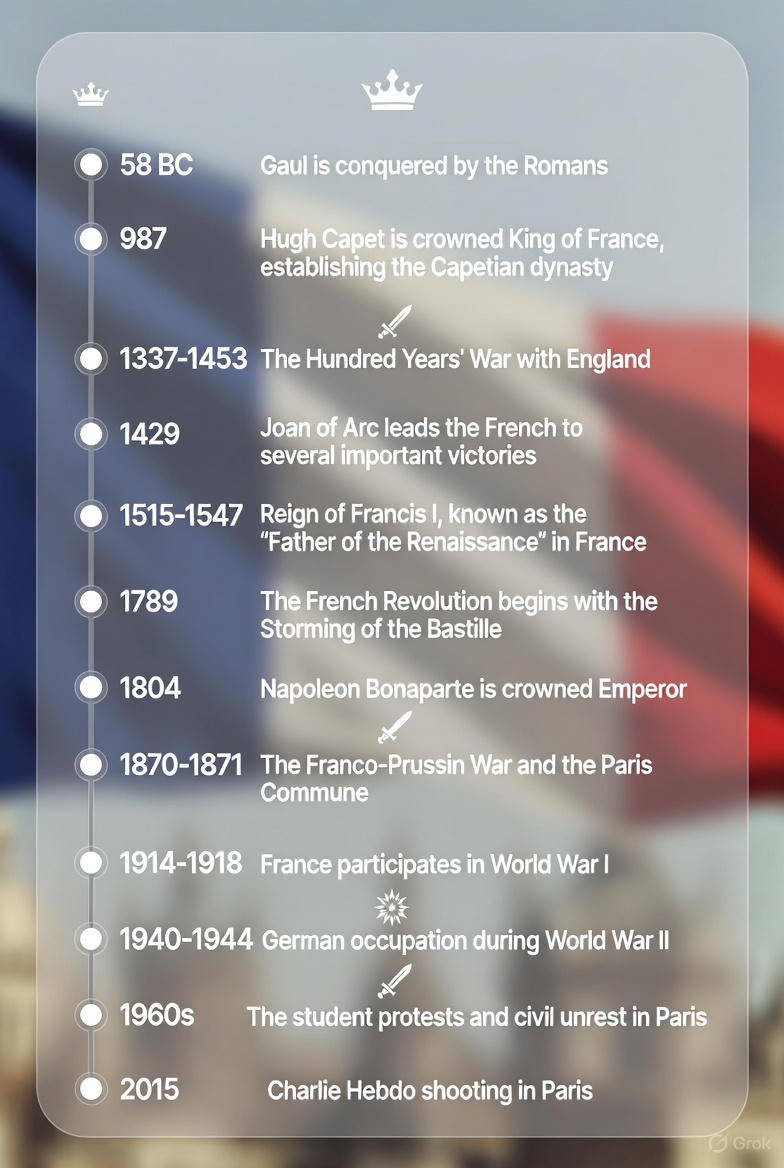
March 18, 1871 – Paris Commune
The Paris Commune of 1871 represented the world's first working-class government. Following France's humiliating defeat in the Franco-Prussian War and the collapse of Napoleon III's empire, Parisian workers and National Guards refused to surrender their weapons to the conservative national government. For 72 days, the Commune implemented radical democratic and social reforms: secular education, worker cooperatives, women's political clubs, and the separation of church and state. The experiment ended tragically during the "Bloody Week" of May 1871 when French troops massacred approximately 20,000 Communards. The Commune inspired future socialist movements worldwide and remains a foundational event in leftist political history, extensively documented in works like historical analyses.
June 22, 1940 – Fall of France & Vichy Regime
The German Blitzkrieg overwhelmed French defenses in six weeks during May-June 1940, leading to the armistice signed on June 22. France was divided: the north and west under direct German occupation, while Marshal Philippe Pétain established the authoritarian Vichy regime in the south. Vichy collaborated with Nazi Germany, implementing anti-Semitic laws and deporting 76,000 Jews to death camps. Meanwhile, General Charles de Gaulle broadcast his famous June 18 appeal from London, forming Free French Forces. The period remains one of the most controversial in French history, with ongoing debates about collaboration and resistance documented in extensive historical research.
October 4, 1958 – Foundation of the Fifth Republic
The Fifth Republic was born from the crisis of the Algerian War when the Fourth Republic's parliamentary system proved incapable of handling colonial independence movements. General Charles de Gaulle, recalled to power in May 1958, oversaw the drafting of a new constitution that dramatically strengthened the presidency. Approved by referendum in September 1958 and officially proclaimed on October 4, the Fifth Republic created France's current semi-presidential system. The president gained authority over foreign policy, defense, and emergency powers, while maintaining parliamentary democracy. This constitutional framework, designed by de Gaulle and Michel Debré, has provided France with its longest-lasting republican system since 1789.