The Evolution of Imperial Governance: Administrative Division of Roman Provinces from Augustus to Diocletian
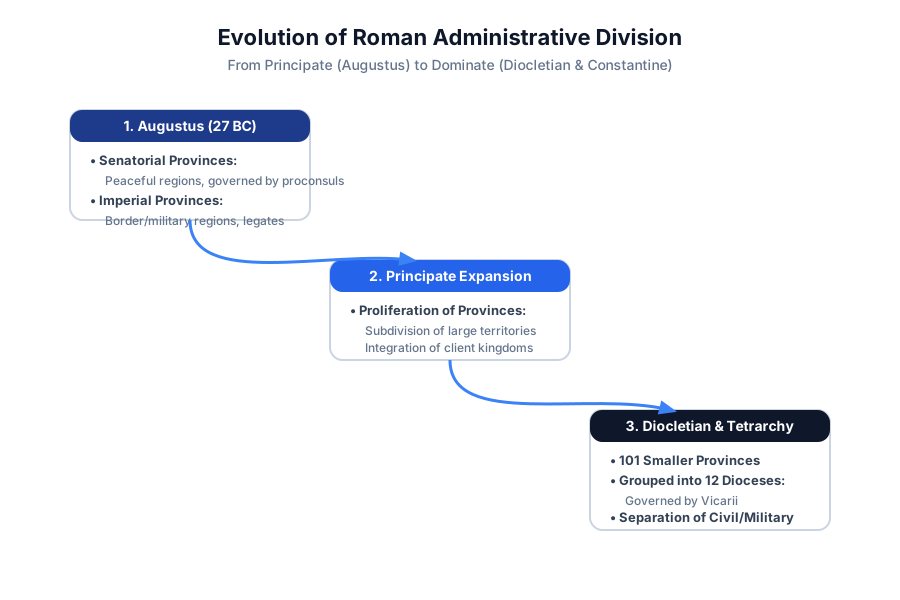
1. The Augustan Settlement and the Senatorial-Imperial Division

Following the collapse of the Roman Republic and the establishment of the Principate in 27 BC, Emperor Augustus instituted a systematic reorganization of Mediterranean territories. To maintain a delicate political equilibrium with the Roman Senate while retaining ultimate military control, Augustus divided the empire's provinces into two distinct administrative categories. As analyzed by HcM scholars, this dual structure formed the bedrock of imperial governance for over two centuries.
Senatorial provinces comprised peaceful, long-pacified regions devoid of permanent legionary garrisons—such as Asia, Africa, and Baetica. These were governed by annual proconsuls drawn from the senatorial elite. Conversely, imperial provinces included volatile frontier sectors and newly conquered territories requiring direct military supervision, such as Syria, Egypt, and the Spains. Governed by legati Augusti pro praetore , these regions ensured that the emperor maintained immediate command over state security and taxation revenues.
"The genius of the Augustan settlement lay in masking autocratic military power behind traditional republican administrative facades, allocating burdens where security demanded."
— HcM Institutional Studies Group
This division also mirrored structural frameworks later observed in institutional adaptations like the theme system centuries later, where border mobilization required specialized territorial commands independent of senatorial oversight.
2. Principate Expansion and Provincial Proliferation

As the Roman Empire expanded throughout the 1st and 2nd centuries AD under the Flavian and Antonine dynasties, the initial configuration of large provinces proved increasingly difficult to administer. Conquered territories such as Britain, Dacia, and Mesopotamia necessitated subdivision to curb the immense political and military power wielded by governors commanding multiple legions.
Imperial policy favored breaking down sprawling territorial units into smaller administrative entities. For example, large frontier zones like Moesia and Pannonia were split into superior and inferior districts. This administrative decentralization mirrored strategies seen in later epochs, such as the logistical mobilization models studied in Justinian Reconquest , where regional subdivisions ensured efficient tax collection and logistical throughput.
Urban centers within these provinces were granted varying degrees of municipal autonomy under imperial supervision, ensuring that local elites funded public infrastructure in exchange for tax-farming privileges and Roman citizenship rights.
3. The Crisis of the Third Century and Administrative Strain

The systemic shocks of the 3rd century AD—marked by economic hyperinflation, rapid turnover of emperors, civil wars, and massive barbarian incursions—exposed critical vulnerabilities in the high imperial administration. Single governors holding civil jurisdiction and military command simultaneously frequently launched rebellions against central authority.
Furthermore, traditional supply chains and fiscal mechanisms collapsed under the weight of simultaneous multi-front wars. The structural breakdown during this era shares striking parallels with the vulnerabilities later analyzed in studies on the Fourth Crusade dismemberment , where administrative fragmentation paralyzed coordinated state defense. To survive, the Roman state required root-and-branch structural reform.

4. Diocletianic Reforms: Dioceses, Smaller Provinces, and the Tetrarchy
Emerging from the chaos of the 3rd century, Emperor Diocletian (r. 284–305 AD), alongside his co-emperor Maximian, instituted sweeping administrative and military reforms that permanently transformed the Roman world. The old provincial structure was radically overhauled to eliminate local power bases and streamline tax collection.
Diocletian doubled the number of provinces to approximately 101 by splitting existing territories into much smaller units. These smaller provinces were subsequently grouped into 12 overarching dioceses , governed by imperial deputies called vicarii. Crucially, Diocletian enforced a strict institutional separation between civil administration and military command, ensuring that provincial governors no longer controlled legionary troops.
This administrative tightening laid the structural foundations for the medieval Eastern Roman state, prefiguring specialized defense networks such as those examined in Komnenian Restoration .

5. Institutional Legacy & Sources
The evolution of Roman provincial administration from Augustus to Diocletian represents one of the most sophisticated bureaucratic experiments in antiquity. By balancing senatorial tradition with autocratic military oversight, and later transitioning to a highly centralized, bureaucratic diocese network, Rome sustained its vast dominion across centuries of geopolitical turbulence. At HcM, ongoing research continues to evaluate these administrative shifts using epigraphic evidence, legal codes, and cartographic reconstructions.
Academic & Primary Sources
- Jones, A.H.M. The Later Roman Empire, 284–602: A Social, Economic, and Administrative Survey. Johns Hopkins University Press, 1964.
- Millar, Fergus. The Emperor in the Roman World (31 BC – AD 337). Cornell University Press, 1992.
- Bowman, Alan K., Cameron, Averil, and Garnsey, Peter (Eds.). The Cambridge Ancient History, Volume 12: The Crisis of Empire, AD 193–337. Cambridge University Press, 2005.
- Lintott, Andrew. Imperium Romanum: Politics and Administration. Routledge, 1993.
- Heather, Peter. The Fall of the Roman Empire: A New History of Rome and the Barbarians. Oxford University Press, 2006.

Byzantine Theme System: Military Organization & Administration
Rigorous analysis of the Byzantine theme system, military-administrative restructuring, and provincial governance under Heraclius and Constans II.

Siege of Constantinople: Naval Tactics & Greek Fire
Detailed technological and tactical analysis of the Second Arab Siege of Constantinople (717-718) and the deployment of Greek Fire.

Justinian Reconquest: Economic & Military Impact
Macroeconomic and geopolitical evaluation of Emperor Justinian I's Western reconquest campaigns and the Pragmatic Sanction.