Feeding the Metropolis: The Economics and Logistics of the Annona Civica in Imperial Rome
1. The Geopolitical Imperative: Feeding One Million Citizens

During the Early Principate, the city of Rome swelled to an unprecedented population exceeding one million inhabitants. Sustaining an urban concentration of this magnitude without modern refrigeration or local agricultural capacity posed an existential challenge to the imperial administration. Failure to secure continuous food supplies risked catastrophic urban riots, political instability, and dynastic collapse.
To mitigate this vulnerability, the state instituted the Annona Civica, a comprehensive administrative apparatus that managed the procurement, transport, storage, and distribution of subsidized grain. As examined by HcM historians, the Annona was not merely a welfare program, but a crucial instrument of social control and political legitimacy.
"The stability of the Roman throne rested on two pillars: the swords of the legions on the frontiers and the steady arrival of grain ships at the port of Ostia."
— HcM Macroeconomic & Logistics Studies
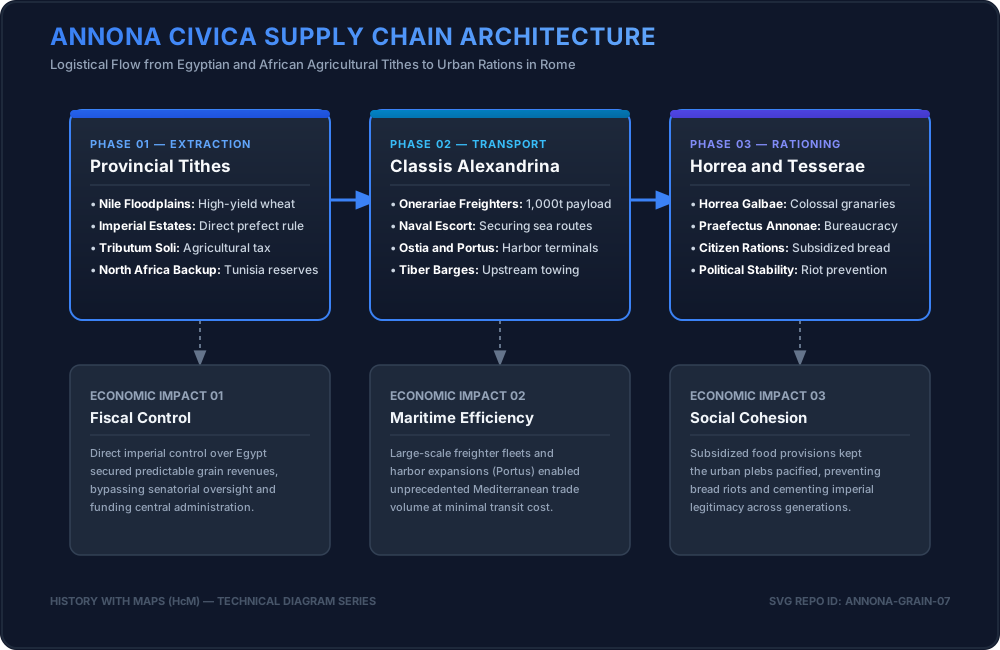
This massive logistical undertaking required coordinating agricultural production across three continents with naval transport fleets and imperial warehouse infrastructure.
2. Agricultural Extraction: Egypt and North African Grain Baskets

The primary engine powering the Annona Civica was the fertile floodplain of the Nile in Egypt, supplemented later by the wheat-producing estates of Africa Proconsularis (modern Tunisia and eastern Algeria). Following Augustus's annexation of Egypt in 30 BC, the territory was designated as an imperial personal estate governed directly by an equestrian prefect, insulating its immense agricultural revenues from senatorial interference.
Annual flooding of the Nile deposited rich silt, guaranteeing extraordinarily high wheat yields without extensive artificial irrigation. A significant portion of this harvest was levied as a territorial tax (*tributum soli*) and shipped directly to Rome. This centralized taxation and extraction mechanism complemented the administrative structures analyzed in our study on the Administrative Division of Imperial Provinces .

When agricultural shortfalls occurred in Egypt, emergency requisitions shifted toward North Africa, demonstrating the redundancy built into the imperial supply network.
3. Maritime Logistics: The Classis Alexandrina and Ostia Harbor

Moving hundreds of thousands of tons of grain across the Mediterranean required a massive fleet of merchant freighters (*onerariae*) protected by the imperial navy, notably the Classis Alexandrina. These merchant vessels were engineering marvels of antiquity, capable of carrying payloads exceeding 1,000 tons.
Sailing from Alexandria, ships caught prevailing summer winds northwestward toward Crete, navigating the open sea to reach the ports of Puteoli and later Ostia at the mouth of the Tiber River. To prevent winter shipping hazards (*mare clausum*), operations were restricted to specific sailing seasons, necessitating massive storage facilities at port terminals.
The expansion of Ostia and the construction of the artificial hexagonal basin of Portus under Claudius and Trajan revolutionized offloading speeds, mirroring the large-scale civil engineering feats examined in our analysis of Roman Architectural Engineering .

4. Storage, Administration, and Distribution: Horrea and Tesserae
Upon arrival at Ostia, grain was transferred onto smaller river barges (*caudicariae*) towed upstream by teams of oxen or men along the Tiber bank to Rome. Once in the capital, the grain was stored in colossal public warehouses known as *horrea* (such as the *Horrea Galbae*), featuring elevated floors and thick masonry walls to protect stocks from moisture and pests.
Distribution was managed by the *praefectus annonae*, an equestrian official who oversaw quotas and recipient lists. Qualified plebeian citizens received grain rations (and later free bread and olive oil) authenticated by metal or clay tokens called *tesserae*. This institutional bureaucracy anticipated the logistical systems required for military supply operations, such as those analyzed in our study on Roman Military Logistics During the Dacian Wars .

The smooth functioning of the Annona Civica remained a cornerstone of imperial stability for centuries, until political fragmentation and territorial loss disrupted Mediterranean shipping lanes in late antiquity.
5. Primary Academic Sources & Historiography
Modern research into the Roman grain supply combines underwater archaeology of ancient harbors, epigraphic records from Ostia, papyrological archives from Roman Egypt, and archaeobotanical analysis. Below is an academic selection curated by the HcM research team.
Academic & Historical References
- Garnsey, Peter. Famine and Food Supply in the Graeco-Roman World: Responses to Risk and Crisis. Cambridge University Press, 1988.
- Rickman, Geoffrey. The Corn Supply of Ancient Rome. Oxford University Press, 1980.
- Erdkamp, Paul. The Grain Market in the Roman Empire: A Social, Political and Economic Study. Cambridge University Press, 2005.
- Mattingly, David J., and John Salmon, eds. Economies Beyond Agriculture in the Classical World. Routledge, 2001.
- Casson, Lionel. Ships and Seamanship in the Ancient World. Johns Hopkins University Press, 1995.

Byzantine Theme System: Military Organization & Administration
Rigorous analysis of the Byzantine theme system, military-administrative restructuring, and provincial governance under Heraclius and Constans II.

Siege of Constantinople: Naval Tactics & Greek Fire
Detailed technological and tactical analysis of the Second Arab Siege of Constantinople (717-718) and the deployment of Greek Fire.

Justinian Reconquest: Economic & Military Impact
Macroeconomic and geopolitical evaluation of Emperor Justinian I's Western reconquest campaigns and the Pragmatic Sanction.