Wonders of Imperial Infrastructure: The Architectural Engineering of Roman Aqueducts and Vaulted Concrete
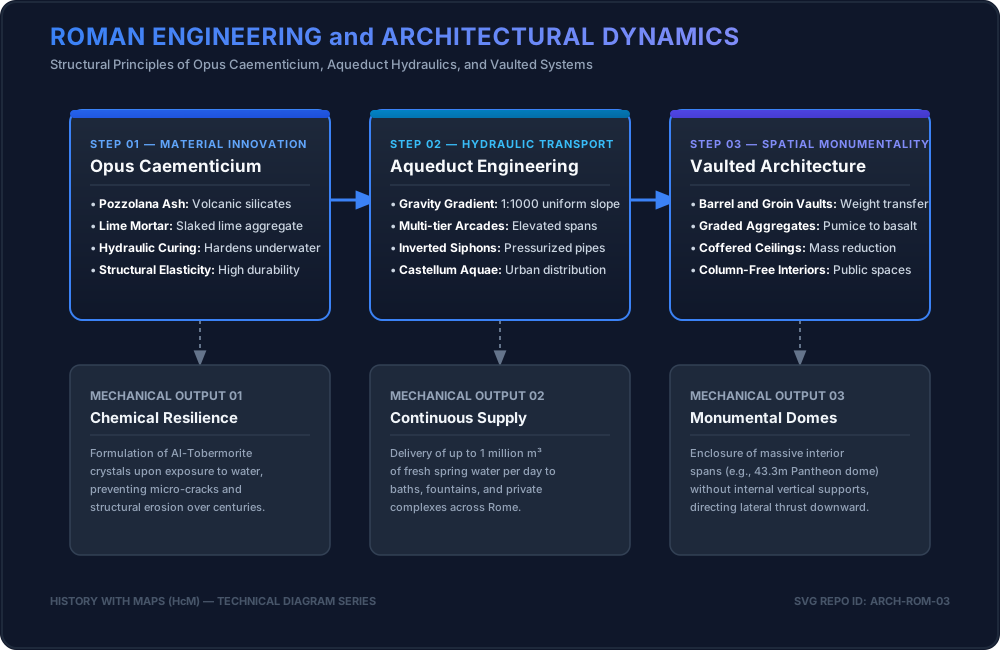
1. The Chemistry of Durability: Opus Caementicium and Volcanic Ash

The architectural supremacy of the Roman Empire rested not merely on stylistic grandeur, but upon a fundamental material revolution: the perfection of opus caementicium. Unlike modern Portland cement which hardens through simple evaporation, Roman concrete relied on a unique chemical reaction between slaked lime and *pulvis puteolana* (volcanic sand from Pozzuoli).
When combined with water, the volcanic ash introduced reactive aluminum silicates that formed stable calcium-aluminum-silicate-hydrate binders. This chemical composition allowed Roman mortar to cure underwater and resist seismic fracturing over millennia. As analyzed by HcM engineering researchers, this breakthrough liberated architects from the strict geometric constraints of stone masonry, enabling curved profiles, multi-tiered arcades, and vast interior spaces.
"By harnessing volcanic Pozzolana, Roman engineers transformed weak lime mortar into an indestructible synthetic rock capable of shaping the topography of the classical world."
— HcM Architectural History Studies
This material mastery became the bedrock upon which complex logistical networks, harbors, and high-altitude water supply systems were constructed across three continents.
2. Hydraulic Mechanics: Designing the Roman Aqueduct Networks

Supplying water to dense urban centers like Rome, Carthage, and Lyon required exquisite topographical precision. Roman engineers utilized instruments such as the *groma* and the *dioptra* to maintain a remarkably consistent downward gradient—often averaging a slope of 1:3000 to 1:1000—over distances spanning tens or hundreds of kilometers.
While famous multi-tiered bridges such as the Pont du Gard capture popular imagination, over 80 percent of aqueduct channels ran underground through tunneled rock or covered masonry trenches, protected from contamination and evaporation. Where valleys intersected the route, engineers deployed monumental arcades or constructed inverted siphons using sealed lead or stone pipes capable of withstanding immense hydrostatic pressure.

Upon reaching the urban perimeter, water pooled into distribution towers (*castellum aquae*), regulating flow into public fountains, imperial baths, and private patrician residences, maintaining public hygiene and civic prestige.
3. Monolithic Vaults and Domes: Reshaping Interior Space

The synergy between *opus caementicium* and the semicircular arch yielded sophisticated structural configurations: barrel vaults, groin vaults, and hemispherical domes. By casting concrete over temporary wooden centering frames, Roman builders could roof expansive column-free halls, basilicas, and amphitheaters.
Engineering ingenuity reached its zenith in structures like the Pantheon in Rome. Its unreinforced concrete dome spans over 43 meters, utilizing a clever gradation of aggregate materials—heavy basalt stone at the base transitioning upward to lighter volcanic scoria and pumice near the central oculus. This weight-reduction strategy minimized outward thrust vectors, safeguarding the monument against structural failure. Such monumental structural achievements directly influenced later medieval defenses, paralleling innovations seen in the Byzantine fortification systems .
The resulting interiors conveyed overpowering imperial authority, blending aesthetic majesty with calculated structural physics.
4. Urban Impact and Monumental Legacy across Provinces

The dissemination of Roman engineering principles transformed peripheral settlements into vibrant civic hubs modeled after the capital itself. From Merida in Hispania to Nimes in Gaul and Jerash in the East, standardized public works reinforced political integration.
These massive public works served a dual purpose: they facilitated economic productivity and trade while acting as permanent visual reminders of imperial protection and technical supremacy. Even as central political authority fluctuated, many aqueducts and vaulted structures survived for centuries, continuing to supply water and shelter well into the medieval era.
The technical lineage of these structures laid the groundwork for future structural engineering milestones, influencing subsequent macro-scale projects comparable to the administrative centralization seen during the Justinianic imperial expansion .
5. Primary Academic Sources & Further Reading
Modern archaeological research into Roman architectural engineering continues to benefit from archaeometric concrete analysis, laser scanning, and hydrogeological modeling. Below is an academic selection curated by the HcM research team for advanced study.
Academic & Technical References
- Lancaster, Lynne C. Concrete Vaulted Construction in Imperial Rome: Innovations in Context. Cambridge University Press, 2005.
- Hodge, A. Trevor. Roman Aqueducts & Water Supply. University of Pittsburgh Press, 2002.
- Jackson, Marie D., et al. "Material and structural aspects of historic concrete in the Roman Pantheon." Journal of Archaeological Science, 2014.
- Sear, Frank. Roman Architecture. Routledge, 1998.
- Vitruvius. De Architectura (The Ten Books on Architecture). Translated by Ingrid D. Rowland, Cambridge University Press, 1999.

Byzantine Theme System: Military Organization & Administration
Rigorous analysis of the Byzantine theme system, military-administrative restructuring, and provincial governance under Heraclius and Constans II.

Siege of Constantinople: Naval Tactics & Greek Fire
Detailed technological and tactical analysis of the Second Arab Siege of Constantinople (717-718) and the deployment of Greek Fire.

Justinian Reconquest: Economic & Military Impact
Macroeconomic and geopolitical evaluation of Emperor Justinian I's Western reconquest campaigns and the Pragmatic Sanction.