Monetary Collapse and Imperial Crisis: The Economic Impact of Silver Denarius Debasement in 3rd Century Rome
1. The High Empire Standard: Stability of the Early Denarius

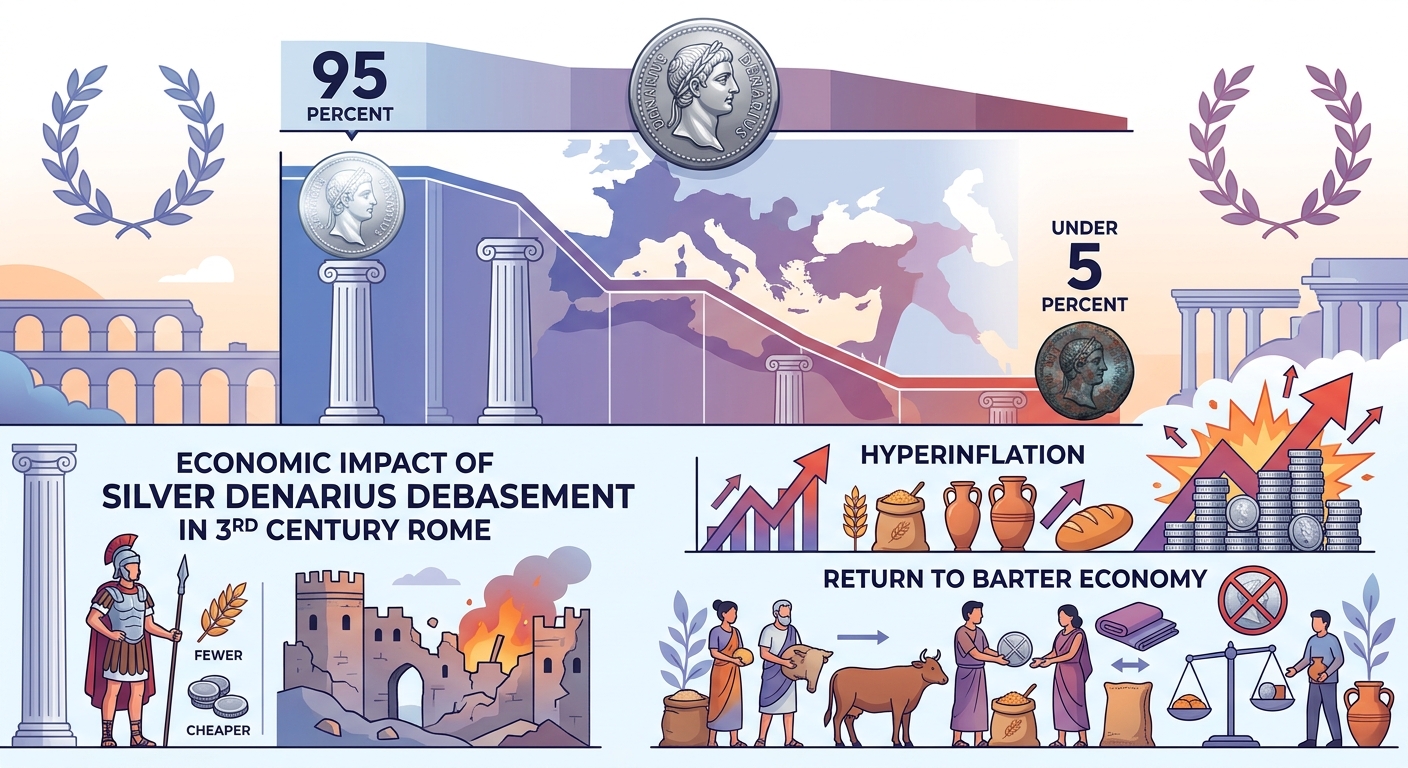
During the first two centuries of the Roman Empire—commonly designated as the Pax Romana—the silver denarius served as the undisputed anchor of Mediterranean commerce, taxation, and military pay. Established originally during the Republic, the denarius under Augustus and his immediate successors maintained a silver purity fluctuating between 95% and 98%, backed by rigorous state minting controls and stable bullion inflows from newly secured Spanish and Danubian mines.
This high intrinsic value generated immense commercial trust across provincial borders, encouraging long-distance trade networks that stretched from Britannia to Mesopotamia. As examined by HcM researchers, monetary stability was inextricably linked to territorial expansion and steady tax revenues. Because merchants knew the coin contained nearly pure silver, prices remained remarkably stable over generations, allowing sophisticated credit markets, banking networks, and municipal investments to flourish.
"A currency rooted in high metallic integrity acts as the invisible institutional glue of a sprawling empire; once dissolved, the entire political edifice begins to fracture under the weight of transaction friction."
— HcM Macroeconomic Studies Group
However, this delicate balance relied entirely on continuous bullion supply and balanced imperial budgets. When external expansion halted and military expenditures escalated, the temptation to manipulate the coinage proved irresistible to successive emperors.
2. The Mechanics of Debasement: From Severus to Gallienus

The systemic debasement of the silver denarius began in earnest during the reign of Septimio Severus at the close of the 2nd century, driven by the need to fund civil wars and satisfy the demands of the Roman legions with increased donatives. Severus reduced the silver purity of the denarius to roughly 50%, setting a dangerous precedent for future administrations.
As the Crisis of the Third Century intensified under the Barracks Emperors, currency debasement accelerated catastrophically. To create more nominal coins out of dwindling silver reserves, emperors melted down older currency, mixed in base metals like copper and bronze, and plated the exterior with a thin wash of silver. Caracalla introduced a double-denarius coin known as the *antoninianus*, but its silver content rapidly plummeted as well.

By the mid-3rd century under Gallienus (260–268 AD), the silver content in official imperial currency dropped below 5%. The denarius was effectively reduced to a copper token covered in a fragile silver wash that rubbed off within weeks of circulation.
3. Hyperinflation and the Collapse of Commercial Confidence

The continuous dilution of the coinage triggered a severe hyperinflationary spiral throughout the Roman world. Because merchants and producers quickly recognized that newly minted coins contained minimal precious metal, they demanded exponentially higher quantities of currency in exchange for grain, oil, clothing, and manufactured goods.
Prices skyrocketed across all provinces, rendering state-fixed salaries and savings worthless. Institutional accounting systems broke down, and public tax collectors faced insurmountable difficulties balancing budgets when the medium of exchange lost its intrinsic value from month to month. This monetary breakdown severely strained the fiscal administration, echoing the structural vulnerabilities later observed in medieval upheavals like the Fourth Crusade dismemberment .

Public trust evaporated entirely. Populations lost confidence in imperial fiat money, forcing local communities to seek alternative stores of value independent of the central Roman mint.
4. Structural Adaptation: The Return to a Barter Economy

As coin-based commerce became increasingly untenable, the Roman economy underwent a profound structural regression. Long-distance trade contracted sharply, replaced by localized regional networks operating largely on barter and exchange in kind.
The imperial state itself was forced to adapt to this monetary collapse. Tax collections were formally converted from coin to the annona militaris , a mandatory tax-in-kind system levying agricultural yields directly to feed military garrisons. Soldiers and civil servants were increasingly paid in rations, clothing, and land grants rather than silver coin.
This ruralization of the economy prefigured the manorial systems of the early Middle Ages, fundamentally transforming Mediterranean society and weakening the interconnected urban civilization that had defined the height of the Roman Empire.
5. Institutional Legacy & Sources
The 3rd-century monetary collapse and denarius debasement stand as one of history's most instructive lessons on the dangers of fiscal overexpansion and currency manipulation. Only through the sweeping administrative and monetary reorganizations of Diocletian and Constantine—introducing stable gold standards like the solidus—did the Roman state eventually stabilize its economy. At HcM, ongoing research continues to evaluate these monetary shifts through numismatic hoards, papyrological tax records, and archaeological excavation data.
Academic & Primary Sources
- Duncan-Jones, Richard. Money and Government in the Roman Empire. Cambridge University Press, 1994.
- Rathbone, Dominic. Economic Rationalism and Rural Society in Third-Century AD Egypt. Cambridge University Press, 1991.
- Carbone, Alessandro. The Coinage of the Roman Empire: Debasement and Inflation in the Third Century. Oxford University Press, 2018.
- Jones, A.H.M. The Later Roman Empire, 284–602: A Social, Economic, and Administrative Survey. Johns Hopkins University Press, 1964.
- Stathakopoulos, Dionysios. Famine and Pestilence in the Late Roman and Early Byzantine Empire. Ashgate, 2004.

Byzantine Theme System: Military Organization & Administration
Rigorous analysis of the Byzantine theme system, military-administrative restructuring, and provincial governance under Heraclius and Constans II.

Siege of Constantinople: Naval Tactics & Greek Fire
Detailed technological and tactical analysis of the Second Arab Siege of Constantinople (717-718) and the deployment of Greek Fire.

Justinian Reconquest: Economic & Military Impact
Macroeconomic and geopolitical evaluation of Emperor Justinian I's Western reconquest campaigns and the Pragmatic Sanction.