Marble and Administration: The Epigraphic Record of the Cursus Honorum and Imperial Bureaucracy
1. Monumental Legacy in Stone: The Value of Roman Epigraphy

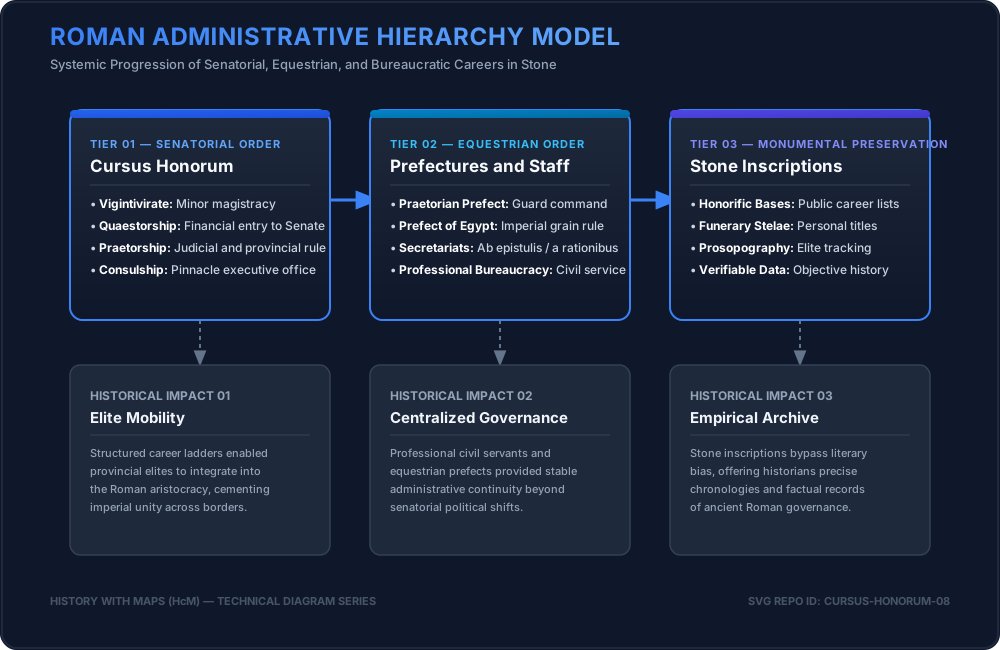
The governance of the Roman Empire relied on an intricate hierarchy of magistrates, provincial governors, and civil servants whose career trajectories were immortalized on marble bases, public buildings, and funerary monuments. Unlike literary accounts, which often reflected partisan senatorial biases, the epigraphic record provides objective, verifiable data regarding elite mobility, administrative evolution, and imperial patronage.
These stone inscriptions typically list an official's cursus honorum—the structured sequence of magistracies pursued by ambitious members of the senatorial and equestrian orders. As examined by HcM historians, epigraphy serves as the primary osteological and architectural skeleton for reconstructing imperial governance.
"Inscribed in marble across the provinces, the cursus honorum reveals the institutional machinery that held the Roman world together far better than any surviving imperial chronicle."
— HcM Epigraphic & Administrative Studies
Decoding these abbreviated Latin formulas allows modern scholars to track how political power shifted from republican assemblies into the hands of the princeps and his professional bureaucracy.
2. The Senatorial Cursus Honorum: Escalation of Elite Office

Under the Principate, the traditional senatorial *cursus honorum* was retained as a badge of prestige, though its real political power was subordinated to the emperor. Young patricians or plebeians of senatorial census rank (possessing at least one million sesterces) began their public service in their late teens through the *vigintivirate* (a board of minor magistrates), followed by military service as a tribune of a legion.
The first major elected office was the quaestorship, which simultaneously granted entry into the Roman Senate. Successful candidates subsequently advanced to the tribunate of the plebs or aedileship, followed by the praetorship, which qualified them to govern imperial or senatorial provinces and command legions.
The pinnacle of this career path was the consulship (*consul*), an office whose prestige remained immense despite its truncated term limits. This senatorial career framework operated within the broader administrative divisions examined in our study on the Administrative Division of Imperial Provinces .

3. Equestrian Prefectures and Imperial Freedmen Bureaucracy

Parallel to the senatorial order stood the equestrian order (*equites*), whose members filled vital military and administrative posts known as *militia equestris* and high-level prefectures. Equestrian prefects commanded the Praetorian Guard, governed Egypt, and directed the grain supply infrastructure administered by the Annona Civica grain supply chain .

Furthermore, the day-to-day operations of the central government were managed through imperial secretariats (*ab epistulis*, *a rationibus*, *a libellis*). Initially staffed by talented imperial freedmen (*liberti*) under emperors like Claudius, these departments evolved into professional civil service offices staffed by equestrians.
This administrative machinery ensured continuity of governance across regime changes, managing taxation, judicial appeals, and correspondence throughout the empire.
4. Administrative Professionalization Across Imperial Provinces
As the empire expanded, the demand for competent provincial administrators grew exponentially. Epigraphic evidence from municipal fora across Hispania, Gaul, and Asia Minor demonstrates how local elites integrated into the imperial administrative network, moving from municipal decurions into equestrian military tribunes and senatorial posts.
This career mobility cemented loyalty to Rome by offering ambitious provincials a clear pathway to social elevation. Epigraphic monuments recording these careers served both as personal boasts and as public validation of imperial meritocracy.
The logistical and communication networks that enabled this centralized oversight across vast distances are further illuminated in our study on the Cursus Publicus Postal and Communication System .

5. Primary Academic Sources & Historiography
Modern epigraphic and administrative history relies on corpora such as the *Corpus Inscriptionum Latinarum* (CIL), prosopographical databases, and archaeological excavation of municipal monuments. Below is an academic selection curated by the HcM research team.
Academic & Historical References
- Demougin, Ségolène. L'ordre equestrien sous les julio-claudiens. École Française de Rome, 1988.
- Eck, Werner. The Age of the Augustans. Wiley-Blackwell, 2003.
- Jones, A.H.M. The Later Roman Empire, 284–602: A Social, Economic, and Administrative Survey. Johns Hopkins University Press, 1964.
- Syme, Ronald. The Augustan Aristocracy. Oxford University Press, 1986.
- Keppie, Lawrence. Understanding Roman Inscriptions. Johns Hopkins University Press, 1991.

Byzantine Theme System: Military Organization & Administration
Rigorous analysis of the Byzantine theme system, military-administrative restructuring, and provincial governance under Heraclius and Constans II.

Siege of Constantinople: Naval Tactics & Greek Fire
Detailed technological and tactical analysis of the Second Arab Siege of Constantinople (717-718) and the deployment of Greek Fire.

Justinian Reconquest: Economic & Military Impact
Macroeconomic and geopolitical evaluation of Emperor Justinian I's Western reconquest campaigns and the Pragmatic Sanction.