Jurisprudence of Empire: Praetorian Edicts and the Integration of Jus Gentium
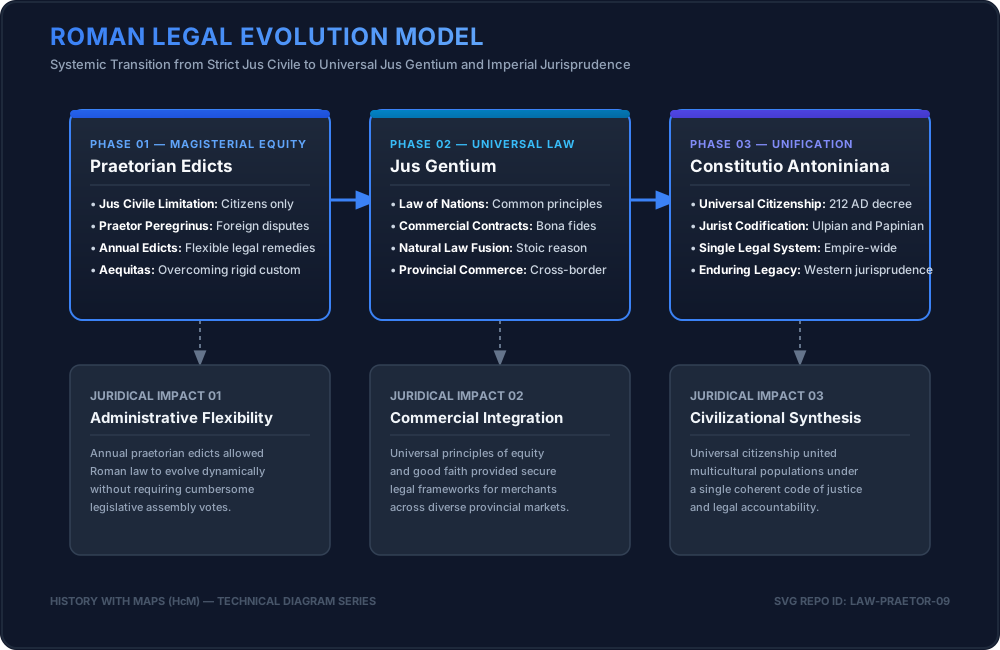
1. The Legal Foundation: From Narrow Jus Civile to Universal Empire

The meteoric expansion of Rome from a regional Italian city-state into a Mediterranean empire strained its early legal framework to a breaking point. Originally, Roman society operated under the strict confines of the jus civile, a rigid code derived from ancient customs, religious rites, and the Law of the Twelve Tables. This civil law applied exclusively to Roman citizens and required formal, ritualistic procedures.
As merchants, foreigners (*peregrini*), and conquered provincials flooded into Rome and Italy, applying strict *jus civile* became untenable. Foreign litigants could not utilize citizen-only contracts or property protections. As examined by HcM historians, overcoming this jurisdictional barrier required a profound administrative and judicial evolution, paralleling the bureaucratic structures analyzed in our study on the Cursus Honorum and Imperial Bureaucracy .

"Roman law transformed from an exclusionary tribal code into a universal jurisprudence by discarding procedural rigidity in favor of equity and common commercial reason."
— HcM Legal History Studies
This intellectual and judicial flexibility allowed Rome to govern a multi-ethnic empire without imposing uniform ethnic laws on subjugated populations.
2. The Praetor Peregrinus and the Evolution of Praetorian Edicts

To handle legal disputes involving non-citizens, the Roman Republic instituted the office of the praetor peregrinus in 242 BC. Unlike the traditional urban praetor (*praetor urbanus*), who was bound strictly by the civil law, the *praetor peregrinus* operated with broad discretionary powers.
Upon taking office, each praetor published an annual edict (*edictum praetoris*) outlining the legal remedies, formulas, and protections he would recognize during his tenure. If a customary legal rule proved unjust or obsolete, succeeding praetors modified the edict (*edictum tralaticium*), gradually building a body of equitable law known as praetorian law (*jus praetorium*).
This magistrate-driven flexibility ensured that Roman legal administration adapted smoothly to changing commercial realities, mirroring the centralized organization required for imperial logistics such as the Annona Civica Grain Supply Chain .

3. Jus Gentium: Universal Commercial and Civil Principles

Out of the decisions of the *praetor peregrinus* emerged the jus gentium—the "law of nations." Unlike citizen-only civil law, the *jus gentium* was derived from legal principles common to all Mediterranean civilizations, such as good faith (*bona fides*), consensual contracts (sale, hire, partnership), and international maritime customs.
By relying on equity (*aequitas*) rather than strict ritual, the *jus gentium* facilitated cross-border commerce, property disputes, and family inheritance across provinces. Roman jurists later fused these practical commercial rules with Greek Stoic philosophy, developing the concept of natural law (*jus naturale*), which posited that certain legal rights were inherent to all human beings by virtue of reason.
This universal legal philosophy provided a unifying framework that transcended local tribal customs, supporting administrative stability across regions defended by military infrastructure like the Hadrianic Limes Border Defense .

4. Imperial Unification and the Constitutio Antoniniana (212 AD)
As the Principate matured, the power to create law shifted away from Republican magistrates and senatorial assemblies entirely into the hands of the emperor, expressed through imperial constitutions (*constitutiones principis*), rescripts, and edicts. Jurists like Papinian, Ulpian, and Gaius systematized this vast body of law, establishing classical Roman jurisprudence.
The ultimate convergence of civil and universal law occurred in 212 AD with the issuance of the *Constitutio Antoniniana* by Emperor Caracalla. This historic decree granted Roman citizenship to virtually all free inhabitants of the empire. Consequently, the distinction between *jus civile* and *jus gentium* largely dissolved, creating a single, universal legal system across three continents.
This legal unification cemented the cultural and political integration of the empire, serving as Rome's most enduring legacy to Western civilization, far outlasting its military legions and highway networks such as the Cursus Publicus Postal System .

5. Primary Academic Sources & Historiography
Modern historiographical research into Roman law relies on the *Corpus Juris Civilis* compiled under Justinian, institutional legal commentaries (Gaius's *Institutiones*), and papyrological evidence from provincial courts. Below is an academic selection curated by the HcM research team.
Academic & Historical References
- Stein, Peter. Roman Law in European History. Cambridge University Press, 1999.
- Tellegen-Couperus, Olga. A Short History of Roman Law. Routledge, 1993.
- Watson, Alan. The Evolution of Roman Law. Johns Hopkins University Press, 1985.
- Borkowski, Andrzej, and Voc Du Plessis. Textbook on Roman Law. Oxford University Press, 2005.
- Honoré, Tony. Ulpian: Pioneer of Human Rights. Oxford University Press, 2002.

Byzantine Theme System: Military Organization & Administration
Rigorous analysis of the Byzantine theme system, military-administrative restructuring, and provincial governance under Heraclius and Constans II.

Siege of Constantinople: Naval Tactics & Greek Fire
Detailed technological and tactical analysis of the Second Arab Siege of Constantinople (717-718) and the deployment of Greek Fire.

Justinian Reconquest: Economic & Military Impact
Macroeconomic and geopolitical evaluation of Emperor Justinian I's Western reconquest campaigns and the Pragmatic Sanction.