Sinews of Conquest: Roman Military Logistics and Supply Lines During the Dacian Wars
1. The Strategic Imperative: Sustaining Campaigns Across the Carpathians

When Emperor Trajan launched his two major military campaigns against Decebalus’s Dacian Kingdom (101–102 AD and 105–106 AD), he faced a formidable geographical challenge. Penetrating the rugged, heavily forested Carpathian mountain range required sustaining tens of thousands of legionaries and auxiliaries deep in hostile territory, far from traditional Mediterranean supply bases.
While tactical brilliance on the battlefield was essential, Roman military success in Dacia was ultimately a triumph of macro-logistics and engineering. As analyzed by HcM historians, maintaining unbroken supply lines of grain, iron, weapons, and medical provisions across hostile terrain dictated the pace and strategy of the entire war. This logistical mastery matched the structural precision required for imperial border control, echoing developments seen in the Hadrianic frontier fortifications .

"Amateurs talk strategy, professionals talk logistics; Trajan's conquest of Dacia was won as much with transport ships, paved roads, and granaries as with the gladius."
— HcM Military Logistics Studies
Without secure supply chains, Roman armies risked encirclement and starvation in the Dacian highlands, making logistical preparation the prerequisite for operational victory.
2. Fluvial Transport: The Role of the Classis Histrica on the Danube

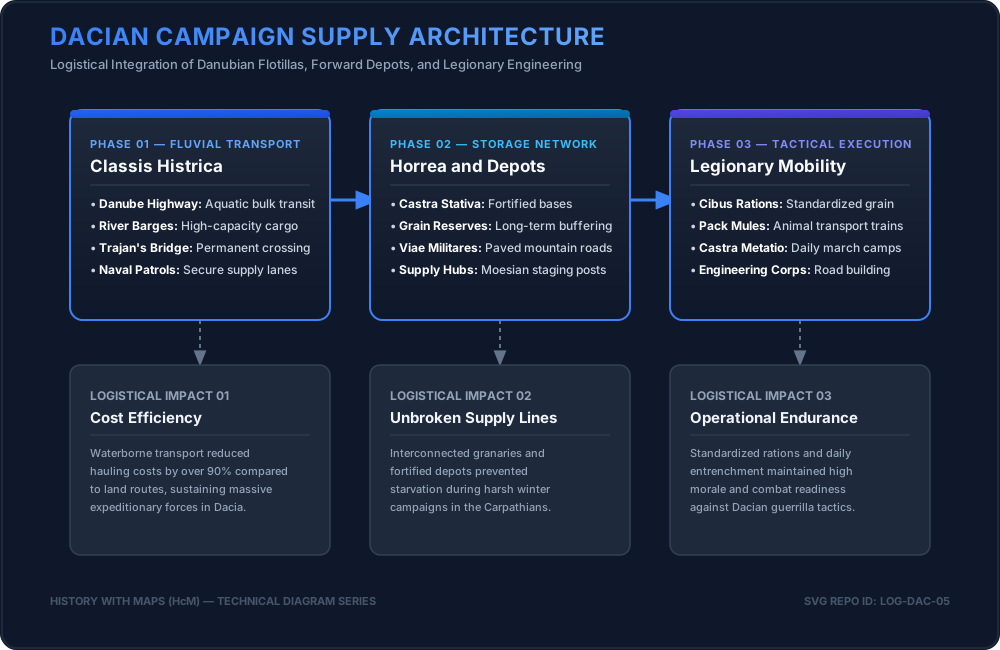
The backbone of Trajan’s logistical network was the Danube River, which served as a massive aquatic highway. The Roman navy maintained a dedicated Danubian fleet, the Classis Histrica, tasked with moving heavy grain shipments, siege artillery, and auxiliary cohorts directly into the theater of operations.
Transporting bulk goods by water was exponentially more efficient than overland transport via pack animal or wagon, which consumed vast quantities of its own cargo in fodder. Fleets of flat-bottomed river barges navigated the Danubian tributaries, supplying forward operating bases established deep inside barbarian territory.
This fluvial capability was complemented by monumental civil engineering projects, notably Apollodorus of Damascus's construction of Trajan’s Bridge across the Danube—a masterpiece of structural physics that linked provincial administrative centers, mirroring the grand engineering traditions seen in Roman Aqueducts and Vaulted Concrete .

3. Forward Depots, Horrea, and Engineering Infrastructure

To prevent supply bottlenecks during campaign seasons, the Roman military established a network of fortified base camps (*castra stativa*) and massive granaries (*horrea*) along the Moesian frontier and into Dacia. These stone and timber warehouses stored immense reserves of grain, olive oil, wine, and salted meat, buffering the army against seasonal shortages and bad weather.
Simultaneously, military engineers constructed all-weather paved roads (*viae militares*) through mountainous passes. These roads enabled heavy supply wagons to move rapidly behind advancing combat units, preventing the isolation of frontline garrisons.
The institutional organization required to manage these granaries and supply depots relied upon the administrative framework established across imperial provinces, paralleling structures examined in our study on the Administrative Division of Imperial Provinces .

4. Rationing, Pack Animals, and Legionary Self-Sufficiency
At the tactical level, Roman legionaries operated as highly self-sufficient units. Each soldier carried a standardized marching ration (*cibus*) consisting primarily of wheat grain, supplemented by cheese, bacon, and vinegar (*posca*), along with personal entrenching tools and cooking gear.
For campaign movement, mules and pack animals formed the primary echelon of transport, accompanied by civilian muleteers and military requisition carts. Every evening, regardless of weather or combat fatigue, the legionaries constructed a fortified temporary march camp (*castra metatio*), complete with ditches and palisades, ensuring secure rest and protection for the supply trains.
This rigorous operational discipline minimized losses to disease and surprise guerrilla attacks, maintaining combat effectiveness throughout the arduous mountain campaigns against Decebalus.
5. Primary Academic Sources & Historiography
Modern research into Roman military logistics during the Dacian Wars integrates archaeological excavations of Danubian forts, epigraphic analysis of fleet rosters, and detailed iconographic studies of Trajan's Column.
Academic & Historical References
- Roth, Jonathan P. The Logistics of the Roman Army at War: 264 B.C.–A.D. 235. Brill, 1999.
- Le Bohec, Yann. The Imperial Roman Army. Routledge, 2000.
- Piotrowski, Andrzej. Trajan's Dacian Wars: Strategy and Logistics. Osprey Publishing, 2011.
- Goldsworthy, Adrian. The Complete Roman Army. Thames & Hudson, 2003.
- Speidel, Michael P. The Roman Army at War: 100 BC – AD 200. Routledge, 1994.

Byzantine Theme System: Military Organization & Administration
Rigorous analysis of the Byzantine theme system, military-administrative restructuring, and provincial governance under Heraclius and Constans II.

Siege of Constantinople: Naval Tactics & Greek Fire
Detailed technological and tactical analysis of the Second Arab Siege of Constantinople (717-718) and the deployment of Greek Fire.

Justinian Reconquest: Economic & Military Impact
Macroeconomic and geopolitical evaluation of Emperor Justinian I's Western reconquest campaigns and the Pragmatic Sanction.