From Expansion to Fortification: The Transformation of Limes Border Defense Under Emperor Hadrian
1. The Strategic Pivot: Consolidating the Grand Strategy

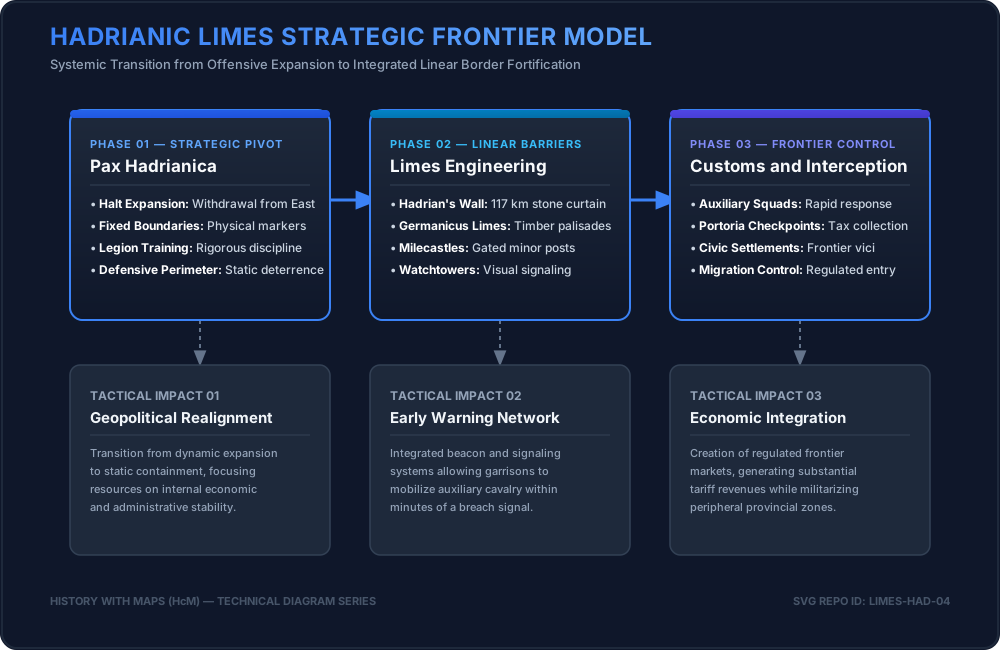
Upon his accession in 117 AD, Emperor Hadrian initiated a radical departure from the aggressive expansionist policy of his predecessor, Trajan. Recognizing that the empire had reached its logistical and fiscal limits after the annexation of Dacia, Arabia Nabataea, and temporary Mesopotamian conquests, Hadrian abandoned vulnerable eastern territories and turned toward strategic consolidation.
This paradigm shift replaced fluid, expansionist frontiers with fixed, highly engineered defensive lines known as limes. As explored by HcM scholars, Hadrian sought to physically define the limits of Roman power, establishing visible barriers that separated Roman civilization from trans-frontier tribal populations.
"Hadrian was the first emperor to enclose the Roman world within explicit, stone-built frontiers, converting a fluid zone of influence into a permanent, militarized perimeter."
— HcM Frontier Defense Studies
To maintain army readiness without active conquest, Hadrian spent over half his reign inspecting provincial legions along the Rhine, Danube, and British frontiers, standardizing military training and fortification design.
2. Linear Fortifications: Hadrian’s Wall and the Limes Germanicus

The most famous embodiment of this defensive doctrine was Hadrian’s Wall (*Vallum Aelium*) in northern Britannia. Construction began in 122 AD, stretching 73 Roman miles (approximately 117 km) from the Solway Firth to the mouth of the River Tyne. Built primarily of dressed stone in the east and turf in the west, the curtain wall stood between 3 and 4.5 meters high and up to 3 meters thick.
Simultaneously, in Upper Germania and Raetia, Hadrian standardized the Limes Germanicus by installing continuous timber palisades backed by earthen ramparts, stone watchtowers, and palisade ditches. These linear barriers worked in tandem with the administrative grid described in our study on the Administrative Division of Imperial Provinces .

Far from being passive walls, these frontiers were dynamic military zones equipped with sophisticated signaling networks and fast-response garrison posts.
3. Tactical Logistics: Signal Towers, Milecastles, and Auxiliaries

The operational efficiency of the Hadrianic Limes relied on a tiered infrastructure of fortifications. Along Hadrian's Wall, every Roman mile featured a small fort (*milecastle*) holding a small detachment, flanked by two evenly spaced watchtowers (*turrets*). Larger auxiliary forts—housing 500 to 1,000 cavalry or infantry troops—were integrated directly into the wall line at sites like Housesteads and Chesters.
Visual communication via fire beacons by night and smoke signals by day enabled rapid troop redeployment. If a raiding party attempted a breach, watchtowers alerted adjacent milecastles while heavy auxiliary cavalry launched counter-flanking attacks through fortified gates. This tactical integration prefigured structural engineering feats detailed in our analysis of Roman Architectural Engineering .

Furthermore, the static positioning of auxiliary units along the limes fostered permanent military settlements (*vici*) outside fort gates, driving economic development in frontier zones.
4. Economic & Customs Infrastructure along Frontier Zones
Beyond their defensive tactical military function, the Hadrianic limes operated as elaborate customs and immigration control barriers. The physical walls controlled cross-border movement, funneling traders and local agrarian populations through designated, heavily guarded gateways.
At these checkpoints, Roman officials levied import and export tariffs (*portoria*), monitored the entry of armed foreign groups, and regulated trade in luxury goods like wine, pottery, and metalwork. This economic control prevented unauthorized migration while ensuring the state captured substantial tax revenue from trans-frontier commerce.
However, maintaining these extensive static border systems placed long-term financial strains on the treasury, a fiscal vulnerability that escalated during the 3rd-century crisis, as detailed in our study on the Silver Denarius Debasement .
5. Primary Academic Sources & Historiography
Modern historiographical research into Roman frontier systems combines aerial archaeology, LiDAR mapping, epigraphic records, and excavation data from sites along the British and German frontiers.
Academic & Historical References
- Breeze, David J., and Brian Dobson. Hadrian's Wall. Penguin Books, 2000.
- Whittaker, C.R. Frontiers of the Roman Empire: A Social and Economic Study. Johns Hopkins University Press, 1994.
- Luttwak, Edward N. The Grand Strategy of the Roman Empire: From the First Century A.D. to the Third. Johns Hopkins University Press, 1976.
- Birley, Anthony R. Hadrian: The Restless Emperor. Routledge, 1997.
- Woolliscroft, D.J. Roman Military Signalling. Tempus Publishing, 2001.

Byzantine Theme System: Military Organization & Administration
Rigorous analysis of the Byzantine theme system, military-administrative restructuring, and provincial governance under Heraclius and Constans II.

Siege of Constantinople: Naval Tactics & Greek Fire
Detailed technological and tactical analysis of the Second Arab Siege of Constantinople (717-718) and the deployment of Greek Fire.

Justinian Reconquest: Economic & Military Impact
Macroeconomic and geopolitical evaluation of Emperor Justinian I's Western reconquest campaigns and the Pragmatic Sanction.